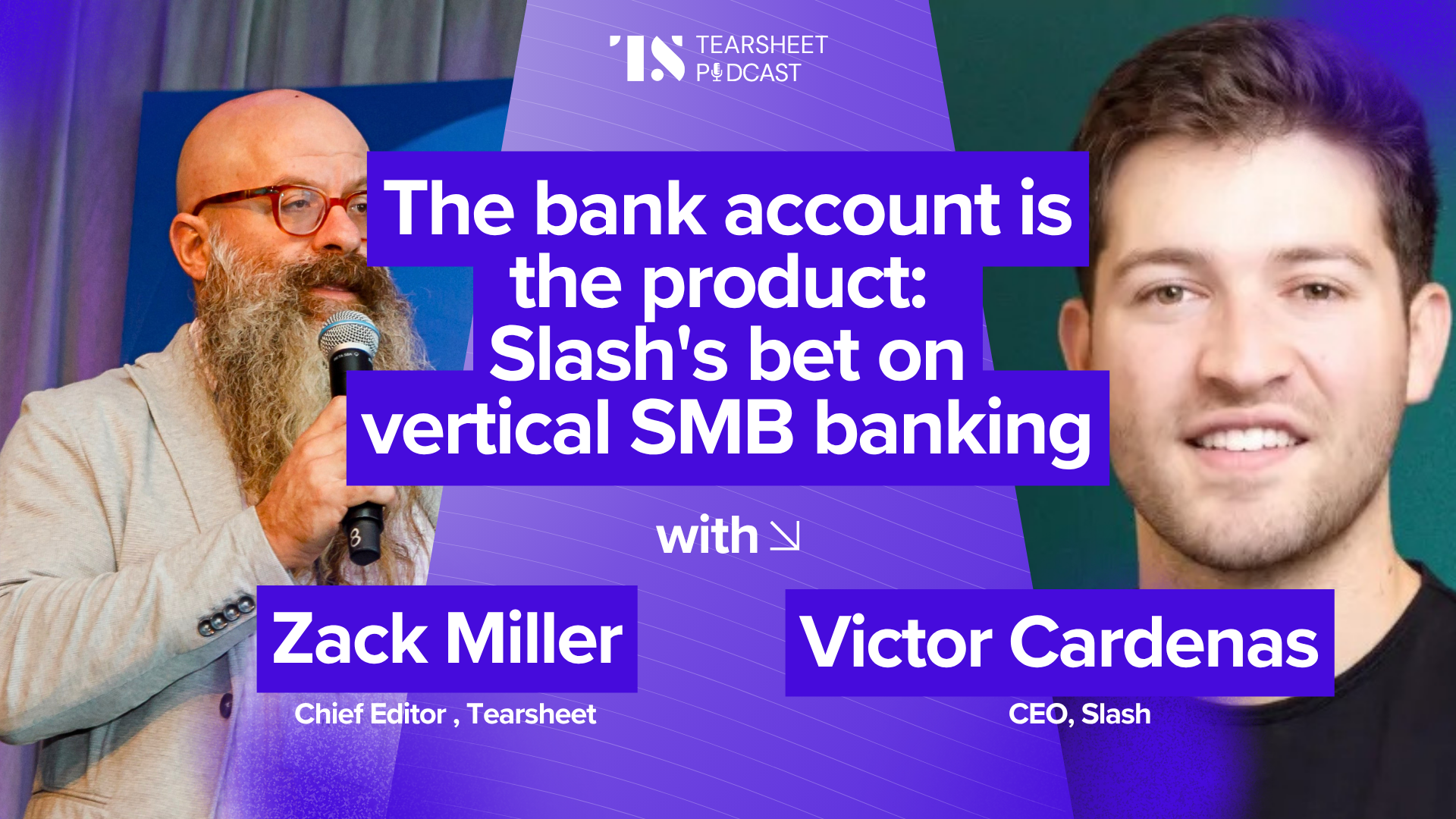
Could your bank account, that most fundamental of financial conduits, actually be… software? It sounds like a trick question, a philosophical debate for a Saturday afternoon. But for Victor Cardenas, co-founder and CEO of Slash, it’s the bedrock of a $1.4 billion business. His thesis is audacious, perhaps even obvious in retrospect: the entity that holds your money should also dictate and deliver the very tools you use to manage it, especially when those tools are deeply entwined with your specific industry’s operational DNA.
This isn’t just about offering a slightly better checking account. This is about dismantling the artificial wall that has long separated the plumbing of finance (the banks) from the intelligence layer (the software). For decades, small businesses have been forced to juggle multiple vendors: one for their operating account, another for their accounting software, yet another for payroll, and perhaps a fourth for payment processing. Each interaction, each data transfer, introduces friction, potential errors, and missed opportunities. Slash aims to obliterate that friction by collapsing these functions into a unified, vertically-integrated offering.
The Pain of the Horizontal Approach
Look, the fintech world is littered with attempts to simplify SMB finances. We’ve seen countless platforms emerge, promising to be the all-in-one solution. But most of them have swung for the fences with a horizontal strategy – trying to build a one-size-fits-all tool for every conceivable business. It’s like designing a single screwdriver and expecting it to fix a car engine, a watch, and a leaky faucet. It might work in a pinch, but it’s rarely optimal, and often downright inadequate for specialized tasks.
Victor Cardenas sees this clearly. His company, Slash, started by catering to a hyper-specific niche: teenage sneaker resellers. Think about that for a second. Not exactly the kind of clientele your typical community bank is clamoring to serve with bespoke solutions. Yet, these were businesses with unique cash flow patterns, specific payment needs (think secondary market transactions, often cross-border or involving niche payment methods), and a critical need for rapid inventory and sales reconciliation. Slash built for them. And it worked.
Now, the company’s grown, processing nearly $3 billion in stablecoin payment volume annually, and it’s expanding its focus to other verticals where the status quo is genuinely painful. We’re talking performance marketing agencies, where ad spend, client payouts, and commission structures create complex financial webs. We’re talking import-export businesses, burdened by international wire fees, customs documentation integration, and fluctuating currency rates. These aren’t abstract problems; they’re the daily grind that eats into profits and diverts precious founder time away from actual business growth.
Why Verticalization is the Real Frontier
This is where Slash’s bet gets truly interesting. Instead of building another generic accounting ledger, they’re building the accounting ledger for a performance marketing agency, complete with automated reconciliation of ad platform spend and client invoices. They’re not just offering a payment gateway; they’re offering a payment solution tailored for import-export, which understands letters of credit and foreign exchange hedging.
“The company holding your bank account should also own all your financial software.”
This isn’t just a marketing slogan; it’s a fundamental architectural shift. By owning the core banking relationship and the deeply integrated vertical software, Slash can do things legacy banks – and even most horizontal fintechs – simply can’t. They have direct access to the raw financial data, enabling more sophisticated AI-driven insights, more intuitive workflow automation, and a more smoothly user experience. It’s the difference between a general practitioner and a specialist surgeon. For complex business needs, you want the specialist.
And let’s talk about the AI. Cardenas hints at serious work on this front, both internally and for customers. Imagine an AI that doesn’t just flag unusual transactions, but proactively optimizes payment schedules based on an import-export business’s supply chain logistics, or one that predicts cash flow for a marketing agency based on campaign performance and client payment histories. This level of predictive and prescriptive capability only becomes possible when you have both the financial data and the industry-specific workflow context baked into a single platform.
The J.P. Morgan Ambition (and its Pitfalls)
Cardenas aspires for Slash to become the “J.P. Morgan for SMBs.” It’s a bold statement, no doubt. J.P. Morgan Chase, despite its own imperfections, offers a continuum of services for businesses of all sizes, from the sole proprietor to the multinational corporation. It’s a financial ecosystem. If Slash can achieve even a fraction of that breadth within its chosen verticals, it will represent a seismic shift in SMB banking. The danger, of course, is overreach. Expanding too quickly, or attempting to serve too many verticals without truly understanding their nuances, could dilute the very specialized value proposition that makes Slash so compelling.
But for now, the focus on deep vertical integration seems right. The $100 million Series C, raised in a funding climate that’s decidedly cooler than its predecessors, underscores the market’s recognition of this strategy. It’s a validation that perhaps the future of business banking isn’t about breadth, but about depth. It’s about becoming indispensable to a specific set of industries by truly understanding and automating their unique financial lives, starting with the bedrock – the bank account itself.
🧬 Related Insights
- Read more: FCA Motor Finance Scheme Faces Legal Storm [Analysis]
- Read more: Visa and Ramp’s AI Agents: The End of Bill-Paying Drudgery?
Frequently Asked Questions
What does Slash actually do? Slash provides business banking services integrated with industry-specific financial software for small and medium-sized businesses, aiming to automate complex workflows and provide tailored financial management.
How does Slash use AI? Slash is reportedly developing AI capabilities to enhance internal operations and provide customers with advanced insights, such as predictive cash flow analysis and optimized payment scheduling, leveraging its integrated data and workflow context.
Will this replace my job? While advanced automation can impact roles, Slash’s focus is on augmenting business operations by simplifying complex financial tasks, allowing founders and employees to focus on strategic growth rather than administrative burdens. Specific job displacement depends heavily on the industry and individual roles.