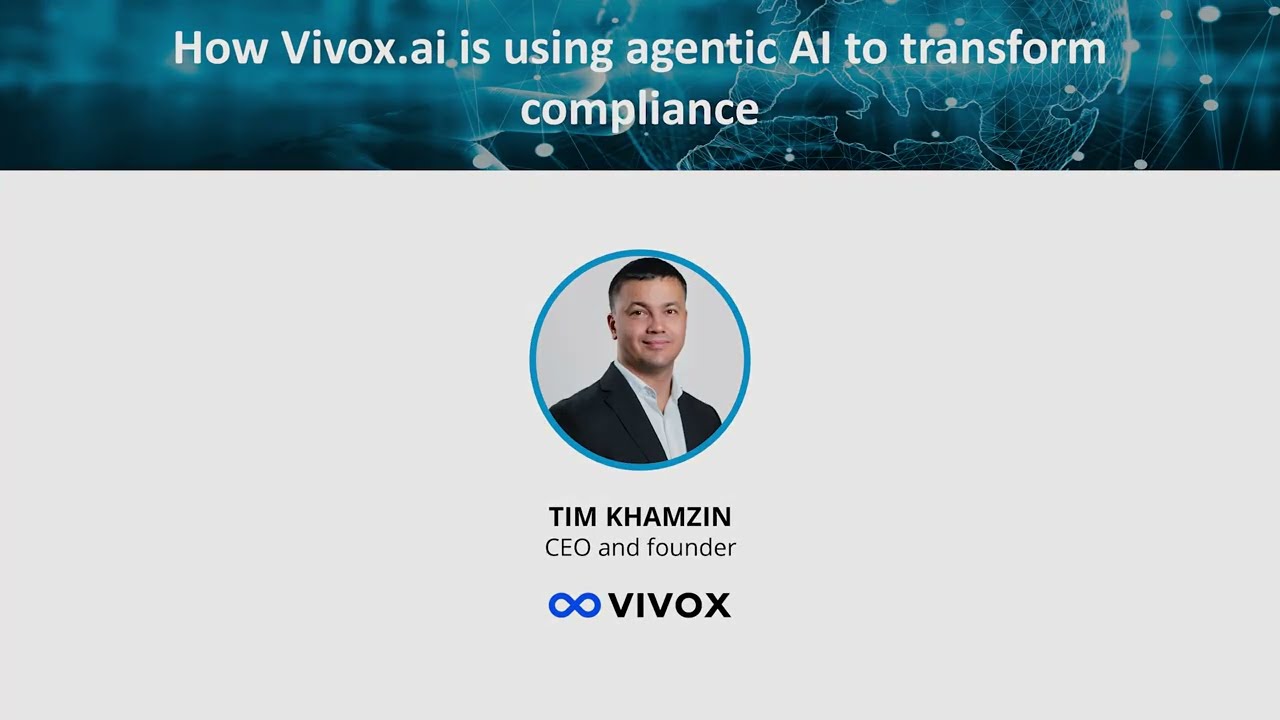
The hum of servers isn’t just background noise anymore; for financial institutions grappling with an ever-thickening regulatory knot, it’s the sound of a ticking clock. Global compliance demands are exploding, and the old playbook—hiring more bodies—is hitting a wall. This is where Vivox.ai, a fresh face founded in 2024, believes it’s found a disruptive edge, not with more dashboards or aggregators, but with what they call agentic AI.
Think of it this way: imagine a seasoned compliance officer, tireless and unfazed by monotony, working 24/7. That’s the promise of Vivox.ai’s digital AI agents. Their CEO, Tim Khamzin, isn’t shy about calling out the industry’s pain points. He points to a significant compliance gap, a chasm that opens when firms scale too rapidly for their legacy infrastructure to cope. Simply expanding human teams, he argues, isn’t the scalable solution. “To address this gap, companies do not need another dashboard, aggregator or orchestrator, they need our digital AI agents that can actually do the work,” Khamzin stated. “We believe AI agents or digital workers are the right path to address this gap.”
Vivox’s mission statement rings with ambition: to transmute compliance from a costly burden into a functional, scalable, and trustworthy operational pillar. Their arsenal? Pre-trained AI agents specifically geared for Anti-Money Laundering (AML), Know Your Business (KYB), and broader financial crime compliance. These agents are engineered to automate the grunt work—the Level 1 analyst tasks like AML checks, adverse media screening, and sanctions watchlists— freeing up human capital for more complex, strategic oversight.
Their flagship offering, Rachel, exemplifies this. It’s pitched as an intelligent AI agent designed for smoothly integration, a digital workhorse that ensures compliance teams can stay perpetually ahead of evolving risks and regulatory shifts. The company claims big names in the EU, UK, Singapore, and the US are already putting Rachel through its paces.
The Onboarding Acceleration: From Days to Minutes?
One of the most striking claims is around business onboarding. Khamzin highlighted this as a particularly potent use case, suggesting that for certain customer profiles, onboarding times can be slashed from days down to mere hours or even minutes. This isn’t just a minor efficiency tweak; it’s a fundamental reimagining of how financial services firms acquire and vet new clients, potentially unlocking significant revenue acceleration.
But how does Vivox.ai actually do this? The architecture behind agentic AI isn’t trivial. It moves beyond simple task automation to embody a more sophisticated form of artificial intelligence. These agents are not just executing pre-programmed scripts; they’re designed to perceive their environment, make decisions, and take actions—autonomously. This implies a sophisticated integration layer that can parse and interact with existing financial systems, a considerable technical hurdle many fintechs stumble over. The ‘trust’ and ‘audit readiness’ Khamzin mentions are paramount here. For regulated industries, the ability to not just perform compliance tasks, but to demonstrate and verify how they were performed is non-negotiable. This likely involves detailed logging, explainability features, and strong security protocols to ensure the AI’s actions are transparent and accountable.
The market is certainly crowded with RegTech solutions. Vivox.ai’s differentiator seems to lie in its commitment to actual agentic action rather than passive oversight. Many competitors offer enhanced analytics or workflow automation tools. Vivox, however, positions its agents as performing the labor of compliance, a subtle but significant architectural shift. They’re not just presenting information; they’re acting on it. It’s a bold claim that, if substantiated, represents a significant leap in how AI can be practically applied within the highly structured and risk-averse world of financial compliance.
The biggest challenge the team has overcome in its journey? Khamzin hints at the complexity of building these agents to be both effective and trustworthy in a domain where errors can have astronomical consequences. Training AI to navigate the nuanced interpretations of regulations, to understand context, and to flag genuine risks—not just keywords—is an immense undertaking. It requires sophisticated natural language processing, machine learning models trained on vast, industry-specific datasets, and a deep understanding of the legal and ethical frameworks governing financial services.
Vivox.ai’s trajectory is one to watch closely. If their agentic AI can reliably deliver on its promise of transforming compliance from a bottleneck into a smoothly, automated function, it could reshape the operational landscape for financial institutions globally. The question remains: can these digital workers truly shoulder the weight of regulatory responsibility, and will the industry embrace them with the trust they demand?
🧬 Related Insights
- Read more: Cross River’s $50M Haul: AI and Crypto Gambit in a Frosty Fintech Winter
- Read more: Stripe’s Adaptive Pricing: Local Currency Boosts Subscriptions by 4.7%
Frequently Asked Questions
What does Vivox.ai’s agentic AI actually do? Vivox.ai uses agentic AI, which are sophisticated AI agents designed to autonomously perform compliance tasks like AML checks, adverse media screening, and KYB verification, aiming to reduce manual work and speed up processes.
Will this AI replace compliance officers? Vivox.ai positions its AI agents as tools to automate repetitive tasks traditionally handled by Level 1 analysts, freeing up human compliance officers for more complex decision-making and oversight rather than outright replacement.
How does Vivox.ai ensure its AI is trustworthy for compliance? Vivox.ai emphasizes building trust through audit readiness, suggesting their AI agents provide transparency and accountability in their actions, likely through detailed logging and explainability features.