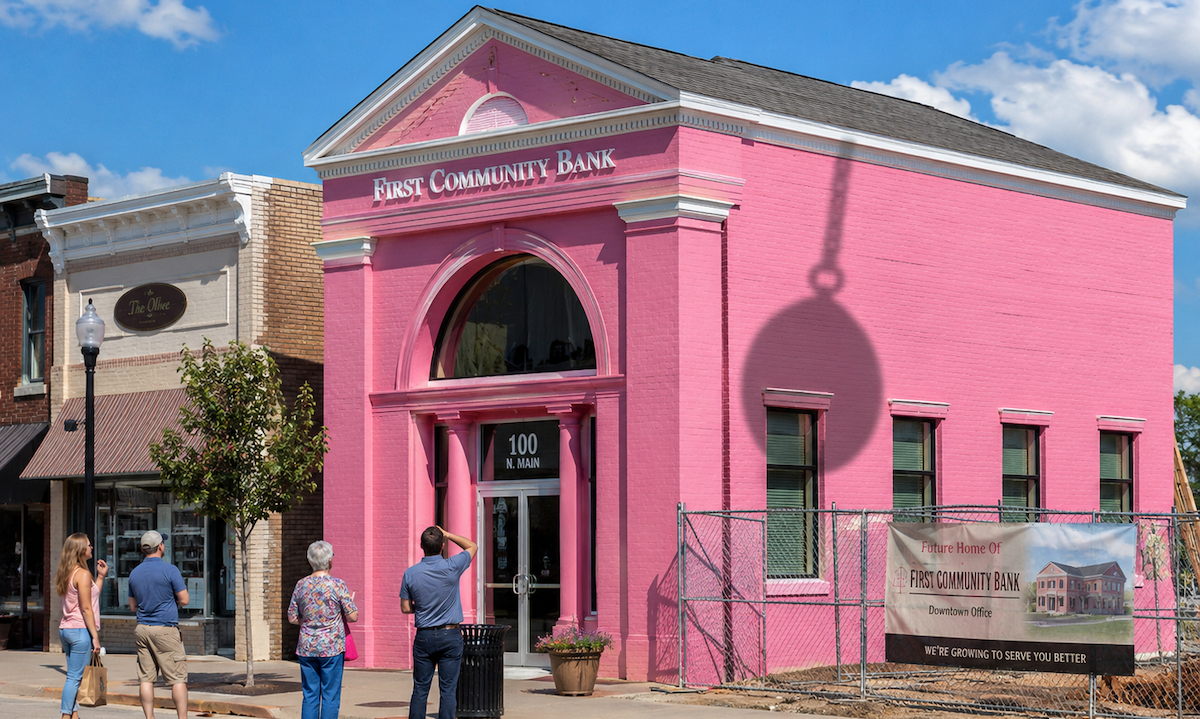
Pink facades. Gone.
That riotous pink exterior on the former Fidelity Bank branch in Easton, Pennsylvania, before its scheduled demolition, wasn’t just an attention-grabbing stunt. It was a canary in the coal mine, screaming a message about the terminal obsolescence of the traditional bank branch as a mere transactional hub. For decades, the branch was the physical embodiment of a bank: deposit checks, ask about overdraft fees, maybe snag a lollipop. But the digital revolution, accelerating at a pace that would make dial-up blush, has fundamentally reconfigured our relationship with money, rendering the branch’s core function — the transaction — largely redundant. Yet, here’s the kicker: branches aren’t vanishing entirely. They’re shedding their old skins.
The Branch is Molting, Not Extinct
ABA’s data reveals a persistent growth in physical footprints over the last four years, a thousand new branches here, a thousand there. This isn’t a denial of digital’s dominance; it’s an adaptation. The branch is being reimagined, not as a place to do banking, but as a place to experience it. Think less ‘transaction box’ and more ‘destination.’ The banks that understand this are actively trying to inject life — and foot traffic — back into these brick-and-mortar stalwarts, trading the sterile, bureaucratic feel for something far more inviting.
From Teller Lines to Lounge Chairs
Bank of America, for instance, is sinking over $5 billion into its network, planning more than 150 new ‘financial centers’ by 2027. This isn’t about making it easier to cash a check; it’s about creating environments conducive to deeper engagement. Wells Fargo is following suit, refurbishing spaces with consult rooms and lounge areas. The goal is palpable: shift the focus from rote transactions to advisory services, financial planning, and relationship building. It’s a subtle but seismic shift, prioritizing human interaction and personalized guidance over the speed of a digital transfer.
Banking as a ‘Third Place’
Then there are the truly innovative — and, frankly, slightly bizarre — approaches. Capital One Cafés are perhaps the most visible example of banking embracing the ‘third place’ concept, blending financial services with the cozy ubiquity of a coffee shop. Free Wi-Fi, quality coffee, workshops, and one-on-one mentoring are all on offer, regardless of your existing relationship with Capital One. It’s a sophisticated play for mindshare and presence, transforming a financial institution into a community hub, where a cold brew might just lead to a deeper conversation about your personal finances. It’s a proof to the idea that if you can’t beat them on speed, out-experience them on comfort and connection.
The Community Center Model
JPMorgan Chase is taking a more grounded, yet equally ambitious, route with its Community Center branches. These are designed as versatile spaces for local events, financial literacy workshops, and small business pop-ups. The underlying logic is compelling: in an app-saturated world, a physical space must offer something inherently digital cannot — human connection, shared experience, and a tangible sense of belonging. It’s about making the bank feel less like an anonymous entity and more like an integrated part of the neighborhood fabric.
Global Experiments: Where ‘Wild’ Happens
Internationally, the experimentation intensifies. Spain’s CaixaBank has created a massive ‘financial experience hub’ in Barcelona, complete with auditoriums and advanced tech. Japan’s Sugamo Shinkin Bank Nakaaoki branch, a vibrant, color-cubed structure, actively seeks to make patrons want to linger. These aren’t just banks anymore; they’re evolving into multifaceted destinations, where the architecture itself is designed to foster engagement and a prolonged presence. It’s a stark contrast to the utilitarian design of yesteryear.
The Rediscovery of Presence
Ultimately, what we’re witnessing is a rediscovery of the power of physical presence. After years of automating away every conceivable human interaction, banks are realizing that for services built on trust and complex decision-making, a tangible, welcoming space is invaluable. The pink branch, slated for demolition, may have grasped this intuitively, understanding that even a doomed building needs a compelling final act. In the digital age, the physical branch isn’t just surviving; it’s adapting, seeking to earn its keep not through transactions, but through building trust, offering expert advice, and fostering community. It’s a high-stakes game of real estate and relationships, where the future of the branch depends on its ability to offer more than just a balance on a screen.
“The punchline is that banks are rediscovering the one thing they spent two decades trying to automate away: presence.”
Is This the End of Digital Banking?
Absolutely not. Digital channels will continue to be the primary interface for most day-to-day banking activities. The transformation of physical branches is a complementary strategy, designed to enhance customer loyalty and address needs that digital alone cannot fulfill, such as complex financial planning, relationship building, and community engagement.
Why Are Banks Investing in Branches Again?
Banks are investing in branches because the nature of banking has shifted. With routine transactions moving to digital platforms, physical branches are being repurposed as spaces for in-depth financial advice, relationship building, community events, and unique customer experiences that digital channels can’t replicate.
What is the ‘Third Place’ Concept in Banking?
The ‘third place’ concept, as applied to banking (e.g., Capital One Cafés), refers to transforming bank branches into comfortable, inviting community hubs that serve as alternatives to home (‘first place’) and work (‘second place’). These spaces offer amenities like coffee, Wi-Fi, and areas for socializing or working, alongside financial services and advice, encouraging customers to spend more time and build stronger relationships with the bank.