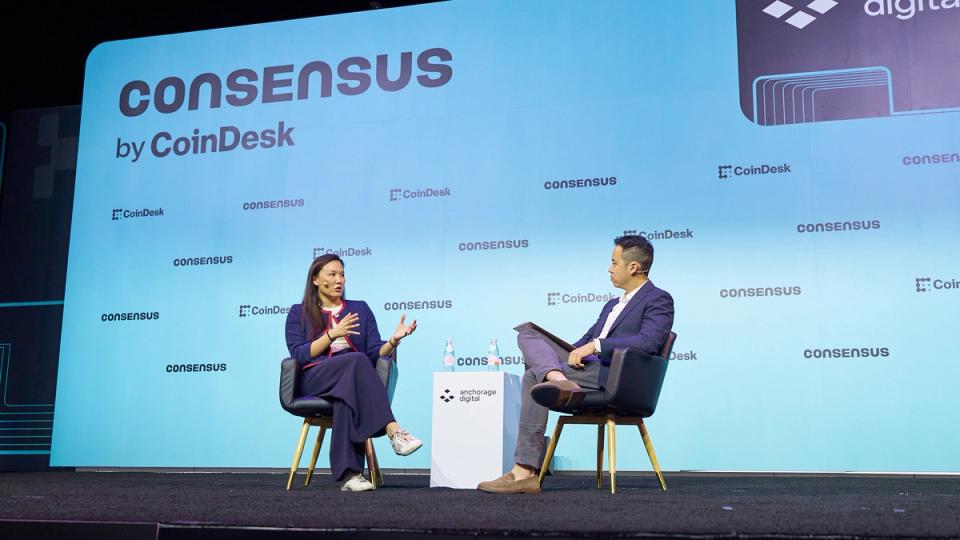
Everyone expected blockchain to disrupt traditional finance for humans. That was the narrative for a decade: faster remittances, cheaper cross-border payments, a digital alternative to dusty banks. But at Consensus Miami 2026, Solana Foundation President Lily Liu served up a different vision, one that moves beyond us. She’s not just talking about payments for people; she’s building the infrastructure for machines to pay machines.
This pivot is significant. For years, the crypto industry has chased institutional adoption, positioning itself as a more efficient Visa or SWIFT. Liu’s argument, bolstered by recent moves from giants like Meta and Western Union adopting stablecoin payments on Solana, suggests that validation is arriving, but perhaps not in the exact way many anticipated. It’s not just about replacing human intermediaries; it’s about creating entirely new economic ecosystems run by AI agents.
The ‘White Whale’ and the Machine
Liu explicitly called out Western Union as the industry’s “white whale” back in 2014. Seeing them now integrate with Solana for stablecoin settlements is, she argues, a profound milestone. It signals that large enterprises are finally viewing blockchain not as a speculative plaything but as essential financial plumbing. Visa’s earlier foray into stablecoin settlement on Solana following an “extensive objective review” further cements this idea: speed and low costs are indeed compelling, but the true value, Liu contends, lies in deep liquidity and a strong developer ecosystem.
But here’s the truly provocative part: Liu’s focus on “agentic commerce.” Think AI agents, autonomously transacting with other AI agents and services. Traditional payment rails, particularly credit card networks, are a non-starter for this. The interchange fees associated with card transactions make micro-payments — the likely currency of machine-to-machine interactions — economically impossible. Solana, with its claimed speed and low transaction costs, can theoretically support these sub-dollar, even sub-cent, exchanges in real-time. It’s a stark departure from the human-centric payment models we’ve known.
Why Does This Matter for Developers?
The implications for developers are immense. If Solana is indeed becoming the rails for an AI-driven economy, this opens up entirely new avenues for application development. Imagine smart contracts that trigger payments based on AI-driven data analysis, or decentralized autonomous organizations (DAOs) managed and operated by AI entities. The architecture of many current dApps is designed for human interaction, with interfaces and user experiences tailored to us. The future Liu paints requires a fundamental reimagining of how decentralized applications function, with a focus on programmatic, automated transactions.
Liu also touched on the recent security incidents within the Solana ecosystem, such as those involving Vault and Drift. Her defense—that preserving industry confidence sometimes trumps competitive rivalries—is a pragmatic stance. In a world where trust is paramount, especially for the nascent AI machine economy, network stability and security will be non-negotiable. This suggests a more centralized approach to ecosystem health might be necessary, a point that will undoubtedly stir debate within decentralized circles.
Beyond Payments: Internet Capital Markets
Liu’s vision doesn’t stop at payments. She posits that blockchain’s ultimate role is as “financial rails first and foremost,” leading to what she terms “internet capital markets.” This concept envisions a future where companies and even sovereign nations can access global capital formation more directly, bypassing traditional gatekeepers. It’s a bold claim, but if the underlying infrastructure can support the kind of autonomous, high-frequency transactions required by AI agents, then expanding that capability to facilitate more direct and efficient capital flows seems a logical, albeit ambitious, next step.
The market dynamics are shifting. The expected trajectory of blockchain was always about making existing financial processes better for humans. Liu’s argument forces a re-evaluation: is the true disruptive potential of blockchain not in optimizing human finance, but in enabling entirely new forms of economic activity that were previously impossible? The data points – Western Union, Meta, Visa – suggest a tangible, albeit nascent, movement in this direction. Whether Solana can successfully build and secure the rails for this AI-driven future, however, remains the critical question. It’s a fascinating bet, one that could redefine what ‘financial infrastructure’ even means.